

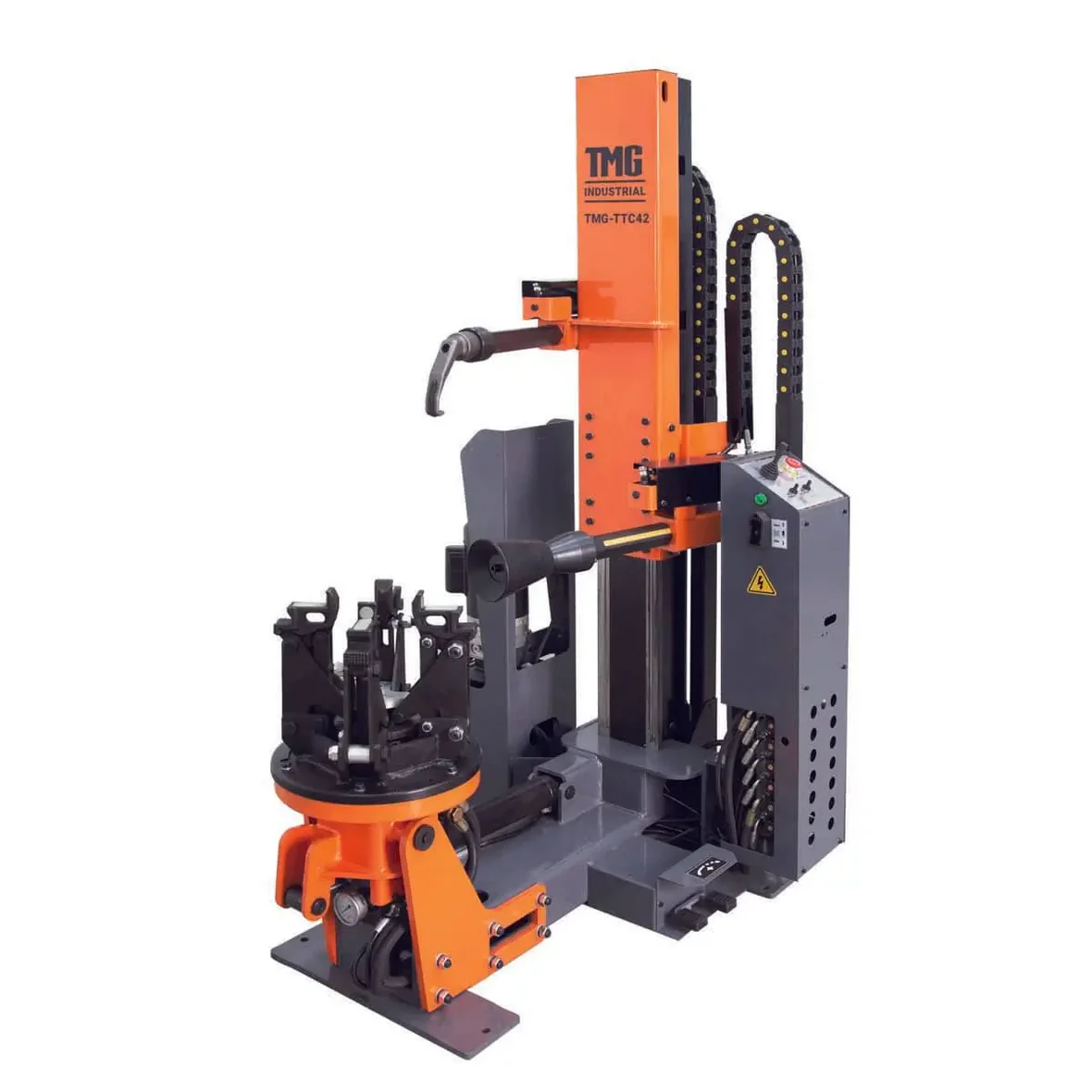
Canada’s trucking industry operates across extreme temperature ranges and varied road surfaces. Tire wear rates increase significantly on the Trans-Canada Highway and remote northern routes. A heavy duty truck tire changer enables fleet maintenance facilities to service large commercial tires in-house. Reducing downtime for tire changes directly impacts delivery schedules and operating costs. A fleet operator in Manitoba reduced third-party service expenses by 60 percent after installing an upright tire changer in their shop.
Technical Overview: Vertical Design and Bead Breaking Mechanics
The upright tower design positions the tire vertically for operator access. This configuration provides clearance for large diameter assemblies. The machine uses hydraulic pressure to operate a bead breaker disc that separates the tire bead from the rim flange. A bead hook then lifts the bead over the rim edge. The mount and demount head arm completes the removal process. The hydraulic clamping chuck with four jaws centres the rim automatically.
Efficiency and Productivity Advantages
Manual tire changes on commercial trucks require multiple tools and significant physical effort. A truck tire changer reduces change time from one hour to approximately fifteen minutes per wheel. The self-centring chuck eliminates manual adjustment steps. The two-position bead breaker arm accommodates different rim diameters without retooling. A regional distribution centre in Ontario reported processing thirty truck tires per day with one technician instead of three.
Technical Fundamentals: Hydraulic and Pneumatic Systems
The machine integrates two power sources. A CSA certified electric motor powers the hydraulic pump that operates the clamping chuck and bead breaker positioning. Separate compressed air lines supply the bead seating and inflation functions. The combination allows precise control of clamping force while maintaining high pneumatic pressure for bead sealing. Hydraulic displacement rated in gallons per minute determines cycle speed.
Performance Factors
- Maximum rim diameter and tire width capacity
- Hydraulic system pressure and flow consistency
- Air compressor capacity for bead seating
- Jaw condition and rim contact surface wear
- Operator familiarity with upright positioning
Safety Practices for Operators
Lock out and tag out procedures must isolate hydraulic and pneumatic energy before maintenance. Operators shall wear steel-toed boots and impact-rated gloves. The inflation process requires a remote locking chuck and safety cage for split-rim assemblies. Never stand directly over the tire during bead seating. Inspect hydraulic hoses monthly for abrasion or cracking. Keep the work area clear of loose tools that may contact moving parts.
Equipment Types and Configurations
Two main configurations serve commercial applications. Upright or vertical tower changers accommodate large diameter truck, agricultural, and off-road tires with rim sizes up to 42 inches. Horizontal changers with lower rim capacities suit smaller truck and light truck tires. The upright design offers better access for heavy assemblies because operators do not lift tires onto a horizontal table. Self-centring hydraulic clamping reduces setup time compared to manual four-jaw systems.
Advantages
- Vertical design reduces lifting and bending
- Hydraulic clamping centres rims automatically
- Integrated bead breaker speeds demounting
- Handles tubeless truck and agricultural tires
- CSA certified motor meets Canadian standards
Limitations
- Requires dedicated floor space for upright operation
- Initial investment exceeds manual tool cost
- Demands compressed air supply at sufficient volume
- Not suitable for passenger car or light truck only shops
- Operator training required for vertical lift assist use
Case Example: British Columbia Logging Fleet
A forestry transport company in Prince George operated a fleet of heavy logging trucks on gravel roads. Tire failures occurred weekly. The company installed an upright heavy duty tire changer in their remote shop. Technicians changed damaged tires on site rather than sending wheels to a dealer 150 kilometres away. The machine paid for itself within eight months through reduced towing and outsourced service charges.
Conclusion and Future Industry Trends
The tire changer market is moving toward fully automated bead seating and inflation systems with pressure monitoring integration. Electric over hydraulic control systems are replacing manual valve operation. Future designs may include integrated tire balancers and radio frequency identification tracking of service intervals. Fleet managers should evaluate tire volume, average rim size, and available shop floor space before selecting a configuration. The upright heavy duty truck tire changer remains the standard for commercial truck and off-road tire service across Canadian fleet maintenance operations.